
Fake love
render vain the boastful sound of your mad speech

Okay finally walked by the Foster + Partners–designed HQ for JPMorganChase, which takes up an entire block between 47th and 48th with its main entrance on Park Ave. I’ve read so much about this building—the reams of negative reviews—so I was prepared for the bronze-ish-ness, the guarded entrance, the anti-human scale, but had anybody mentioned the giant rock(?) and moss(?) walls framing the doors on the Madison Ave side? On F+P’s website I only see massive and offensive geometric abstraction flanking the glassed entrance but I swear these, like, twenty-five-foot walls of rounded rocks with little tufts of too-green moss rose as if trying to convince me that capital had at last not only subjugated but killed “Nature” and resuscitated it zombified for this building, and only for this building, as a reminder as to what the world would now be denied.
These weird walls visually rhymed with the most oddly cladded building I saw on Warren Street in Tribeca, an under-construction condo (I think?) with these tiny slate tiles jittering against one another to an effect a tad more Rainforest Café than 270 Park’s.
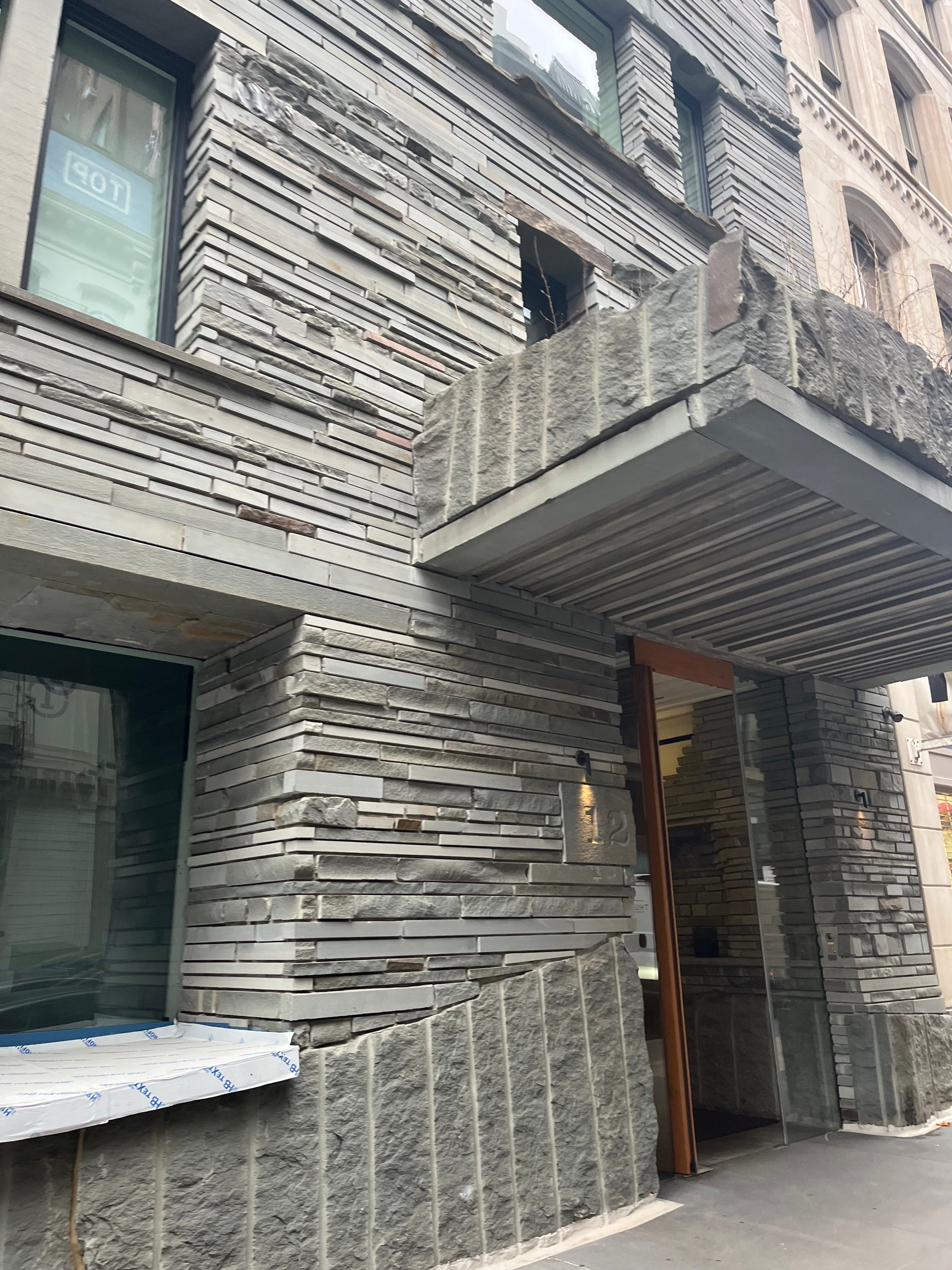
Call it finance kitsch. Call it an insistence that last hope for human intervention has passed. Call it a trick. Call it spectacle which “proclaims the predominance of appearances and asserts that all human life, which is to say all social life, is mere appearance” as architecture, turned media, turned to stone, Medusa’s victim, all the better to lord over the public-private space on Madison Ave whose outdoor Bertoia chairs require constant surveillance and whose plan is so uninviting as to demand the largest placard I’ve ever read insisting, all too firmly, all too firmly as to seem coerced, that this “plaza” in the shadow of this monolith-monument to banking is “open to the public.”
Normally I have limited issue with simulation, although I can take issue with historicism except I do like it, when well-executed, in US churches: I prefer when they appeal to a medieval authority so I don’t have to pretend they’re part of the present as I do when I go to, for example, the Catholic church in Bridgewater, Massachusetts, whose painted drywall I find déclassé. I know this is politically insolvent—and there are places where this appeal to an uninterrupted, perpetually recuperated present-past fails, like at the Vatican, tackiest place on earth—but what I am trying to say is that while the stones on those two façades, most likely made of stone, were deployed in such a way that they looked like they must be anything but their materiality—that in trying to not be cut to square perfection and instead simulating something like a found object in place of a transformed material input they looked far more artificial than any patently synthetic creation—the 1903 landmarked Gothic revival St. Ignatius of Antioch Episcopal Church on the Upper West Side at least had the taste level, so-called, to make me, well, not believe in god, but believe I was in a building that was for believing in god. What could be more imminently unreal—inspiring to faith—than to hang six iron censers from chains in front of another, identical, made in, possibly, silver?
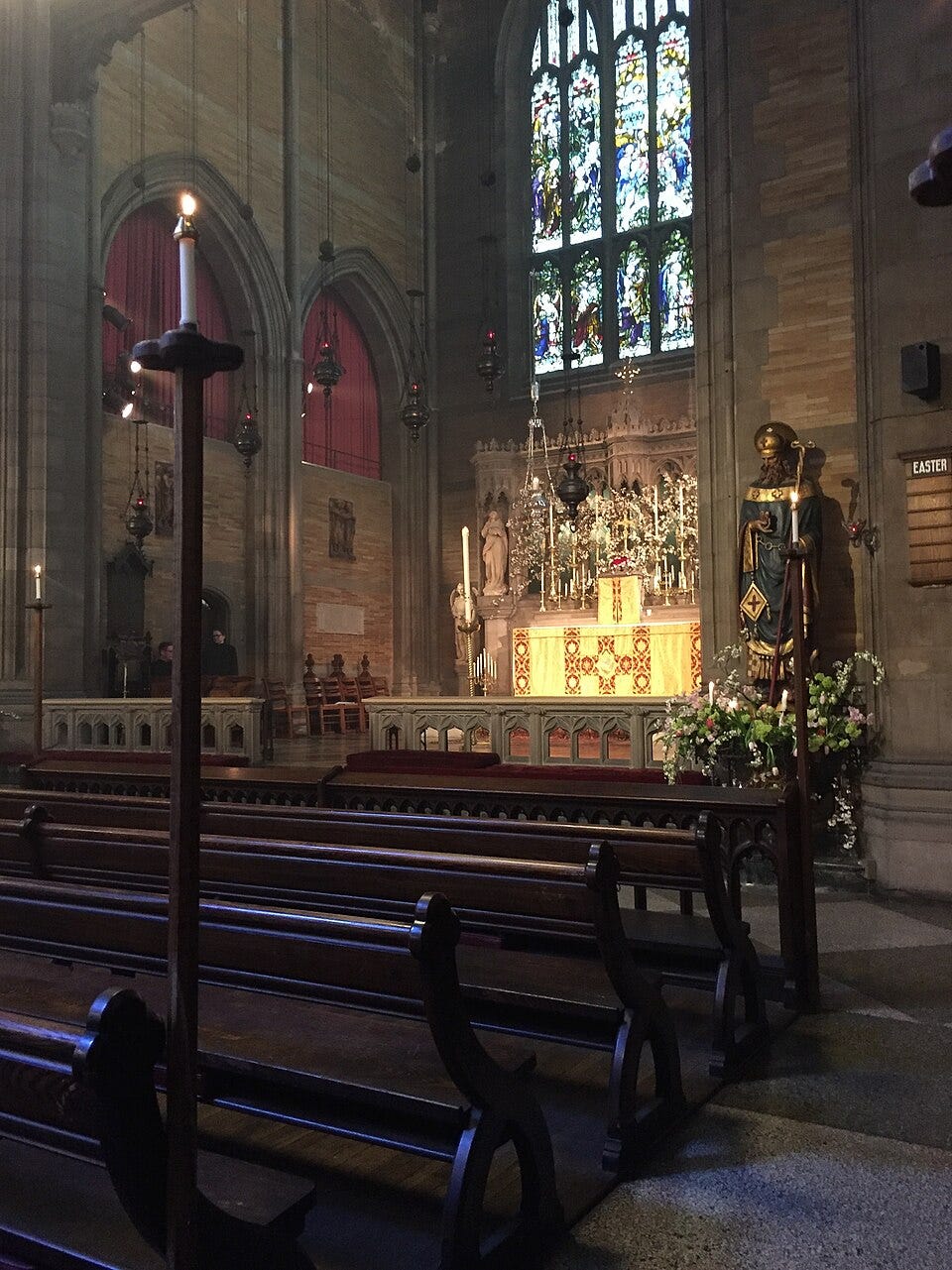
Don’t worry, I have not been transformed or transfigured into the faithful. No, I was there, sitting on a pew, for secular music, believe it or not. A performance by ARTEK of Monteverdi’s first book of madrigals, originally published (dropped?) in 1587.
These polyphonic Renaissance compositions for voice and harp (or at least a harp was used in this performance) largely describe love and death, as well as nymphs (Monteverdi was nineteen when he wrote them). Variously hypnotic, punchy, literal, or abstract were the five compositions, which had introductions between them by a professor, I forget her name, who, 86 years old, we looked it up, had an accent I have only heard in movies from like 1940–70.
What a strange way I structured that sentence but I’m not sure I am motivated to change it.
Anyway, the last of these compositions comprised three parts, with lyrics from a poem by Giovanni Battista Guarini about the fire of rage supplanting love (“you are not worthy of love by such a faithful lover. Ah, you will boast of my pain no more…”), then a poem responding to this poem by Torquato Tasso, basically being like, you “false and insolent” loser, your anger matters even less to me than your love, which probably was as empty as your anger since I guess, if you’re my foe, you weren’t my lover at all, followed by Guarini’s rebuttal…
Okay, the lecturer with the cinematic voice was like, these poets were responding, theoretically, to their discordant POVs on the nature of love, but, um, it sounds a bit more personal than that? Maybe I just see faggotry everywhere (wishful thinking) but “if your shallow mind cares little for my love and even less for my disdain, then anger and love alike will render vain the boastful sound of your mad speech” sounds more like a text from an ex than a proto-baroque Twitter opp.
More importantly, maybe Tasso was hot?

Like, would.
Guarini doesn’t really do it for me, at least in contemporary depictions. Also he seems like an asshole, too. Apparently while Tasso was incarcerated during what was probably a bipolar episode, people took away his work, didn’t give him the profits, and edited it without his consent—Guarini included.
What can I say, I have a type: tall, dark, and manic.
Subscribe to read my smut and my screed on homo mediocrity below. Also: political economy, reading and listening recommendations.
